Showing posts with label peugeot. Show all posts

Monday, August 29, 2011

Peugeot HX1 Hybrid4 MPV Concept


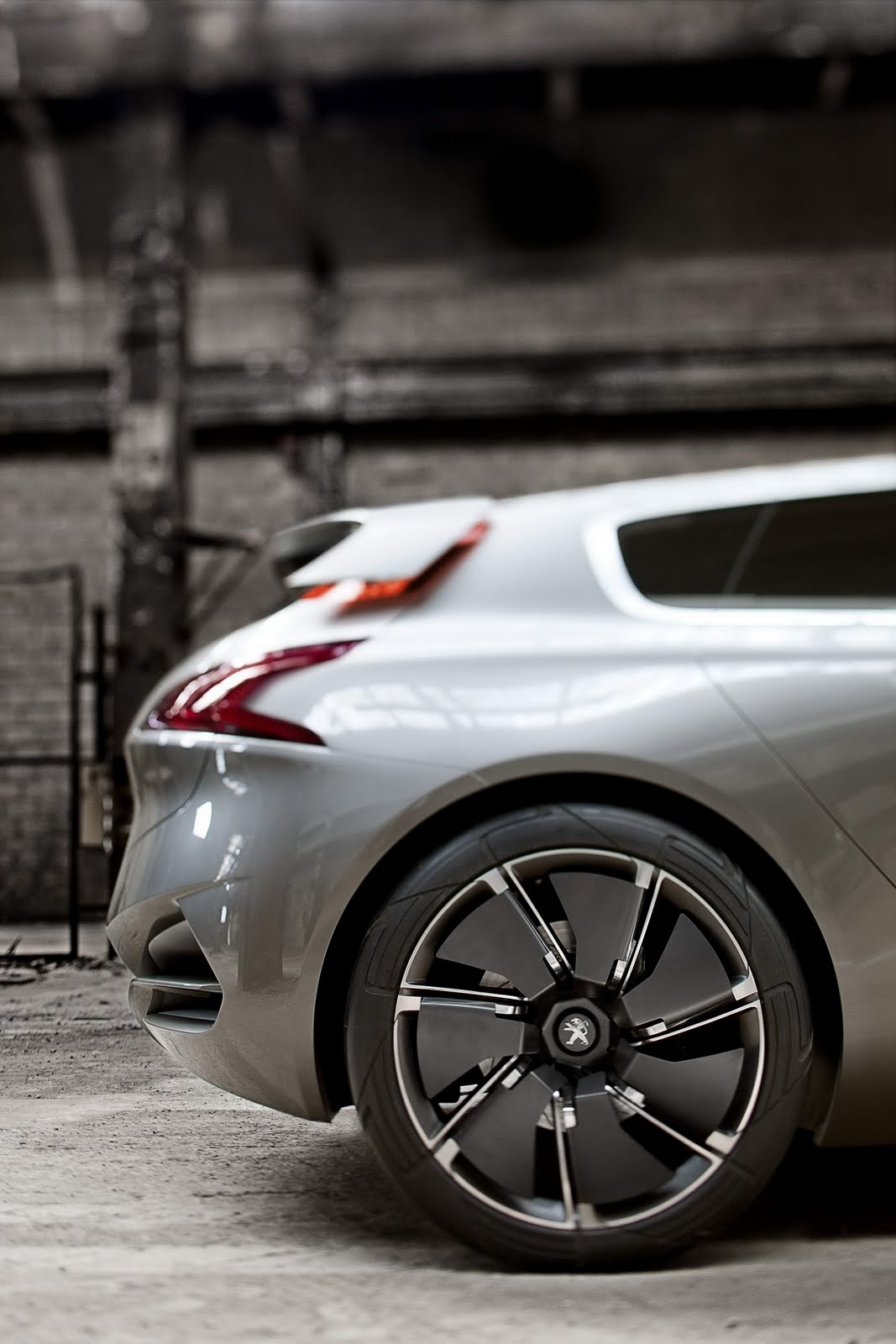
One of the concepts unique features are the seven-spoke alloy wheels that resemble turbine blades when stationary, while when on the move, they open up to form a flat surface for better aerodynamic performance. For the same purpose, a spoiler and two side skirts fitted at the top of the tailgate deploy above 100 km/h (62 mph).


The concept’s theme is named “Metamorphosis”, the Greek word for transformation that indicates the car’s ability to adapt to different driving conditions passenger requirements.
Despite its MPV designation, the HX1 is quite low (1,373 mm), with a large width of 1,990 mm and a length close to 5 meters (4,954 mm).


The HX1 sports four “half-scissor” doors that promise to offer easy access to the cabin, which can accommodate up to six passengers in three rows of seats. A wide array of materials such as natural oak with inlaid fiber optics, brushed metal and leather have been used inside, while Peugeot also added a variety of gadgets like touch-sensitive screens and a marble-adorned center console with a…minibar and coffee machine.


As far as the driver is concerned, the steering column moves electrically along with the seat for easier entry and exit. The steering wheel changes its settings when the driver selects the “cruising” mode for optimal stability and comfort, and the central screen can be adjusted according to the driver’s preferences, with the option of displaying only vital information.
The HX1 is motivated by Peugeot's diesel-electric Hybrid4 powertrain similar to the one offered on the 3008 and from next year, on the 508 RXH.


In the concept, the internal combustion engine is a 204HP 2.2-liter diesel hooked up to a 6-speed auto transmission that powers the front wheels, while a rear-mounted 70 kW (95HP) electric motor turns the rear wheels, making it effectively a four-wheel-drive model. At low speeds, the HX1 can operate on the electric motor alone, emitting zero emissions. The combined maximum combined output of the electric motor and the diesel unit is 220 kW (299HP).


The HX1 takes Peugeot’s hybrid technology one-step further by featuring a plug-in charging capability for its lithium-ion batteries from a standard 240V socket. This enables it to offer a longer range on pure electric mode at 18.4 miles, or 29.6km.


Peugeot said the HX1 returns an average fuel consumption of 3.2 lt/100 km (73.4 US mpg or 88.2 UK mpg) and CO2 emissions of just 83.0 g/km.
Now, if you’re wondering about the silver shoe displayed in some photos, Peugeot says it's “concept shoe” created in collaboration with designer Pierre Hardy who was inspired by the concept car.


Peugeot 508 RXH Diesel-Electric Hybrid Crossover


Based on the estate version of the 508, the RXH follows in the lines of the Audi Allroad and Volvo XC70 featuring a unique front end, flared wheel arches, and of course, higher-riding suspension along with 18-inch wheels and wider tracks.


Unlike other models of the sort, the 508 RXH adopts a new four-wheel-drive system that makes use of an electric motor similar to the one used in the 3008 and the HX1.


The Hybrid4 system comprises a 2.0-liter HDi FAP turbo diesel located up front and an electric motor mounted at the rear. Each motor drives its respective axle, providing four-wheel-drive capability and, at the same time, four modes: Automatic, Sport, 4WD or Zero Emissions when the electric motor is powering the car.


Despite the system's combined output of 200HP, the 508 RXH offers an exceptionally low average fuel consumption figure of just 4.0 lt/100 km (58.8 US mpg or 70.6 UK mpg) and CO2 emissions of 109 g/km.


The 508 RXH will be available from spring 2012, one year after the debut of its 508 stable mate.
Peugeot will also display in Frankfurt a limited edition of the RXH that will be individually numbered and feature a Calern Brown exterior color and alcantara leather upholstery. It will be produced in only 300 units available to order this fall.


Thursday, August 25, 2011

Toyota Camry Daytona 500 Pace Car

Toyota Motor Sales, U.S.A., Inc. (TMS) and Daytona International Speedway (DIS) announced the all-new 2012 Toyota Camry will serve as the official pace car for next year's DAYTONA 500®.
Toyota will showcase the new Camry -- the best-selling car in America for nine years running -- at Daytona in 'The Great American Race,' Feb. 26, 2012. The race annually kicks-off the NASCAR Sprint Cup Series season.
"We're thrilled to be able to feature the new Camry in Daytona at the season's biggest race," said Ed Laukes, TMS corporate manager of motorsports marketing. "We think the DAYTONA 500 is the perfect place to showcase the all-new Toyota Camry -- which will go on sale this fall. We knew when the opportunity arose to partner together with Daytona that it would be an extraordinary way to highlight our new Camry, as well as reinforce Toyota's commitment to NASCAR and its fans."


Toyota Camry went on sale in 1983 and since then more than nine million have been sold in the U.S. Camry has been the best selling car in America for 13 of the past 14 years.
This year marks the 25th anniversary of Camry production in Georgetown, Ky. Toyota began manufacturing the Camry in Georgetown in 1986 and the vehicle is now also built in Lafayette, Ind.
The 2012 Camry debuts a bold, sophisticated new design with a more spacious interior, improved driving dynamics and an even quieter ride than before. The new model features class leading safety, fuel economy and multi-media technology.

"NASCAR and Daytona International Speedway provide a uniquely American platform for manufacturers to display their technology, innovation and overall automotive excellence," said Daytona International Speedway President Joie Chitwood III. "After nearly eight years of competing at NASCAR's highest level, I'm pleased to have the 2012 Toyota Camry pace the DAYTONA 500."
Toyota has previously provided pace vehicles at several NASCAR tracks, including Auto Club Speedway of Southern CaliforniaSM, Charlotte Motor Speedway, Chicagoland Speedway®, Dover (Del.) International Speedway, California's Infineon Raceway, Kansas Speedway®, Martinsville (Va.) Speedway®, Nashville Superspeedway, New Hampshire Motor Speedway, Phoenix International Raceway®, Richmond (Va.) International Raceway®, Wisconsin's Road America and Watkins Glen (N.Y.) International®.
In 2004, Toyota began participating in NASCAR competition by fielding Tundras in the NASCAR Camping World Truck Series (NCWTS). Three years later in 2007, Toyota began competing in the NSCS and the NASCAR Nationwide Series (NNS) with the Camry.
Toyota has won three consecutive manufacturer's titles in the NNS (2008-2010) with the Camry, and Toyota racers have earned one driver's title (Kyle Busch in 2009) and registered 60 race victories in the NNS. In NSCS competition, Camry drivers have earned 36 first-place trophies.
In seven seasons participating in the NCWTS, Toyota has captured five consecutive manufacturer's championships (2006-2010), and Tundra drivers have won driver's titles with Todd Bodine (2006 and 2010) and Johnny Benson (2008), and have earned 88 race wins.
At Daytona International Speedway, Toyota drivers have recorded eight NASCAR wins across NASCAR's three national touring series, including one NSCS win (Kyle Busch in 2008), two NNS wins (Denny Hamlin in 2008 and Tony Stewart in 2008) and five NCWTS wins. In 2008, Hamlin claimed Toyota's first-ever NSCS victory in a non-points qualifying event to determine the Daytona 500 starting lineup.

Friday, August 19, 2011

Lexus GS 350

For this concept, Lexus designers studied characteristics that are often considered contradictory and difficult to execute together,” said Kengo Matsumoto, general manager, Lexus Design Division, Toyota Motor Corporation. “The captivating design of the LF-Gh concept examines the possibility of balancing what are normally opposing qualities, such as style and functionality.”
The Lexus LF-Gh concept takes the company’s L-Finesse design philosophy one step forward and combines style, performance, efficiency, and environmental compatibility with advanced, new technologies. And, as with many other new concepts, the LF-Gh is also a hybrid vehicle.

Just when you thought Toyota had gotten over their 2010 recall catastrophe, their sister brand, Lexus, is starting the year of by catching the proverbial ‘bug’.There really is no rest for the weary, is there.?The Japanese automaker is issuing a voluntary safety recall involving 245,000 vehicles of the GS and IS models over what appears to be a potential defect that could cause fuel leakage.

According to Lexus, the problem is caused by a problem with the connection between the vehicle’s fuel pressure sensor and a fuel line that could loosen over time. This, in turn, could lead to a possible fuel leak.


Tuesday, August 16, 2011

Mazda Shinari Concept

apanese manufacturer Mazda leaking a little performance newest concept cars ‘Mazda Shinari‘ which will be introduced officially at the Paris Motor Show title this year. Shinari use the new front design concept and overall design language for all future Mazda vehicles. In a manner similar to the previous Nagare styling theme, Mazda has created the term “Kodo” for styling a new paradigm. In Japan it means the spirit of motion. The Firm’s Global Design Chief, Ikeo Maeda, as reported by Autocar, say, if Mazda Shinari will become the leader of the latest generation of Mazda’s designs in the future. Mazda Shinari as four-door coupe is a clear signal that the Mazda targeting the premium segment where similar vehicles such as Aston Martin 


RAPIDE, Porsche Panamera and the upcoming Fisker Karma exists. To do so Mazda must improve the level of interior quality. The Japanese word shinari describes the powerful yet supple appearance of great resilient force when objects of high tensile strength, such as steel or bamboo, are twisted or bent. It also refers to the appearance of a person or animal as it flexes its muscles in preparation for a fast movement, and it is these images that form the basis for the name of this concept car.
With a feeling of strength flowing across every panel and part, the Mazda Shinari looks ready to leap forwards at any second. Its form incorporates the expression of a strong backbone running through the body, the sudden release of pent-up energy, and the interplay of beautiful, supple movements. The distinctive front fenders represent the further evolution of the prominent fenders introduced on the RX-8. They highlight the dynamic movement expressed in the sides of Shinari , in a style that is both sporty and elegant. Together with the further three-dimensional sculpting of the front grille, the Shinari design proudly emphasises the Mazda lineage. There is a powerful line of movement originating at the grille and continuing through the bonnet, fender, front lamp modules and bumper. Finally, an aluminium floating bar linking the grille with the headlights enhances the three-dimensional expression of speed. In the interior, Mazda Design has created the ‘ultimate athletic space’ focused on linking ergonomics with basic mechanical functions. It has designed the optimum space for the driver’s cockpit, to enable the driver to focus on the task of driving, as well as the passenger environment, creating a sense of openness. In this model, Mazda Shinari offers new ideas for the human-machine interface in cockpit design, enabling the driver to switch at will between three modes: Business, Pleasure and Sport, to obtain the maximum enjoyment from driving – whatever the purpose of the journey.

Mazda CX-5

Mazda's has revealed its latest concept car, the Kazamai, which is making its global debut at the 2008 Moscow Motor Show.
The name Kazamai can be translated from Japanese to mean 'swirling crosswinds' and this idea can be seen in the design: note the creases on the doors for instance.

More importantly however, the new Mazda Kazamai concept is rumoured to be the precursor to an all-new compact crossover vehicle, which could arrive in the new decade.
This all-new model could go by the name of the CX-5 or CX-4, a potential baby brother of the CX-7 and CX-9 crossover vehicles.
This Japanese concept car is also a coup for the Moscow Motor Show and a sign that the Russian car market is now an important market for mainstream car makers, due to its ability to deliver big revenue.
The Russian new car market recently overtook Germany as the largest in Europe with around 1.65 million annual sales.


Russia's middle class, not unlike China's, is rapidly growing in wealth and this is reflected in things like car sales and the increasing demand for luxury goods in the country of 140 million people.
The new Kazamai concept was designed to gauge the response from this prospering new market, whose sales of SUVs make up a large percentage of the new car market.
According to Mazda, the concept "is a sporty, compact crossover SUV designed especially for the Russian market".
Like Mazda's previous concept cars, such as the Ryuga and Taiki, the new SUV concept car will embody the Japanese car maker's 'Nagare' design philosophy, which can be read as 'flow'.
Mazda says that it's latest concept car "is designed to appeal particularly to younger SUV owners who have a strong sense of style".
"The Mazda Kazamai concept car addresses the growing popularity of SUVs in Russia and gives a strong hint at where Mazda might be going with a compact crossover SUV," says the company. A strong hint... Or perhaps a pre-production design?
As the images reveal, the new concept vehicle will have an overtly sporty design and is likely to be a smaller, sportier version of the CX-7 crossover vehicle.
Mazda has confirmed that the show car will sit on large 22-inch alloy wheels to "lend it high emotional appeal".
The trendy 4WD concept is a bit bigger than the Mazda3, measuring 1930mm wide and 4520mm long, and is powered by a next generation 2.0-litre petrol engine.
This 4-cylinder engine features Direct Injection Spark Ignition (DISI), which facilitates a cleaner burn. This results in more power, but reduces fuel waste and is claimed to improveefficiency by up to 30%. 
The new 2.0-litre DISI engine will also deliver greatly reduced CO2 emissions and is coupled to a 6-speed automatic transmission mated to an four-wheel drive system.
Inside the Mazda Kazamai concept car there is room for four people, and according to its creator it features a "well considered human machine interface" to operate the vehicles controls.
The new concept car also pioneers an advanced body shell.
Mazda says it is employing a new construction method that is the product of a new body structure programme currently being refined by the company, and which features a lightweight structure that gives the car improved levels of crash safety, in the event of a collision.
Other safety features include dynamic stability control (DSC), roll stability control, a pre-crash safety system, and blind spot monitoring to assist lane change.
It even features forward-looking pedestrian safety solutions, such as soft plastic quarter panels and a shock-cone aluminium bonnet that do less damage to the human body.
And this one could be custom made for dangerous areas: a personal security system. This high tech system scans the area both outside and inside the car, and has an automatic alert system which informs the driver in the event of an emergency to help to protect both the owner and occupants.